Web Content Display



The Hua-e Jiaohui Lou Collection
About the Hua-e Jiaohui Lou Collection
Dr Kössen M. T. Ho began building his private collection in 1997, naming it “Hua-e Jiaohui”. In classical Chinese, hua-e refers to the interdependent bond between a flower and its calyx, serving as a graceful metaphor for brotherly harmony. The name is deeply rooted in Dr Ho’s ancestry: the success of his forefathers in the highest imperial examination together earned them the prestigious accolade of “flowers and calyxes shining in mutual splendour”. This elegant title thus holds a dual significance, reflecting Dr Ho’s refined passion for floral motifs and botanical art, while paying homage to his distinguished family heritage.
A highly respected medical professional, Dr Ho has long devoted his time outside of practice to the arts. His journey into bamboo carving began during his doctoral studies in the United Kingdom, sparked by a serendipitous encounter with the renowned scholar Wang Shixiang. Since then, Dr Ho has immersed himself in the field. Going beyond traditional collecting, he actively participates in the creative process, fostering a dynamic dialogue with master painters, calligraphers and skilled artisans to translate ingenious concepts into carved scholar’s objects. The collection features remarkably diverse themes, with works inspired by masterful brushwork or reimagined from antiquities within his own holdings. Meticulously curated and rigorously researched, Dr Ho’s collection is highly cohesive, earning him profound respect within both academic and collecting circles.
Building upon the historical lineage of the Museum’s existing collection of Ming and Qing bamboo carvings, this generous donation from the Hua-e Jiaohui Lou collection opens a new chapter in the study of modern Chinese bamboo craftsmanship. It stands as a true treasure in the art of Chinese bamboo carving.
-
Flowers in Autumn Garden
-
Pu Ru (1896 – 1963)
-
Not dated
-
Album of six leaves, ink and colour on paper
-
Each 36.4 x 20.3 cm
-
Hua-e Jiaohui Lou Collection donated by Dr Kössen M. T. Ho
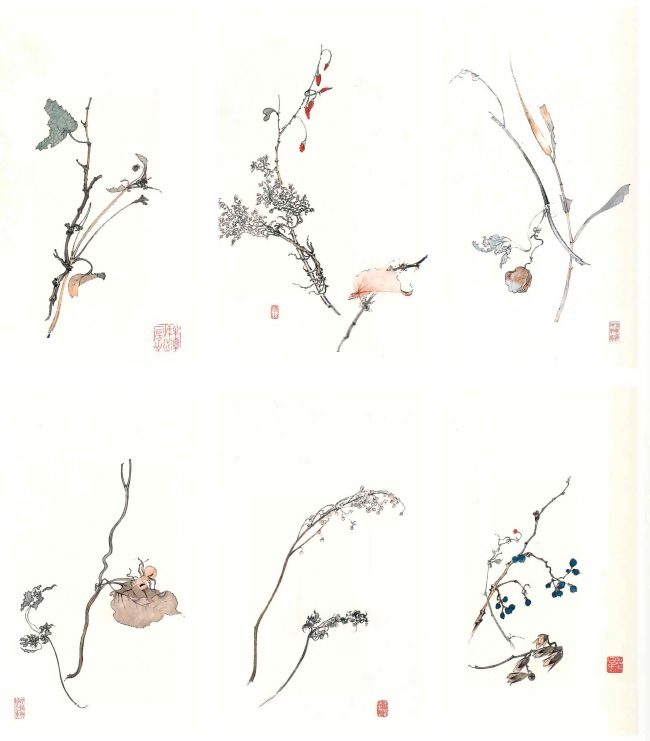
During Pu Ru’s stay at the Cuijin Garden of the Prince Gong’s Mansion, he often used gongbi (fine brushwork) with outlining techniques to depict branch of flowers. Sealed with stamps inscribed with texts like “the bright moon fills the ground with longing” and “barren mountains”, this album reflects the traditional literati’s affection for painting, and also allude to the artist’s feelings of loneliness and nostalgia. In the artwork, slender, withering stems appear as resilient as wires, while the leaves coil as if frosted, and the sepals hang low, seemingly burdened by an unbearable weight. Despite their bleak and sparse appearance, the plants symbolise endurance. This serves as a metaphor for Pu Ru’s own sentiments, where the resilience of the autumnal flora expresses his pride as a loyalist of a fallen empire. -
-
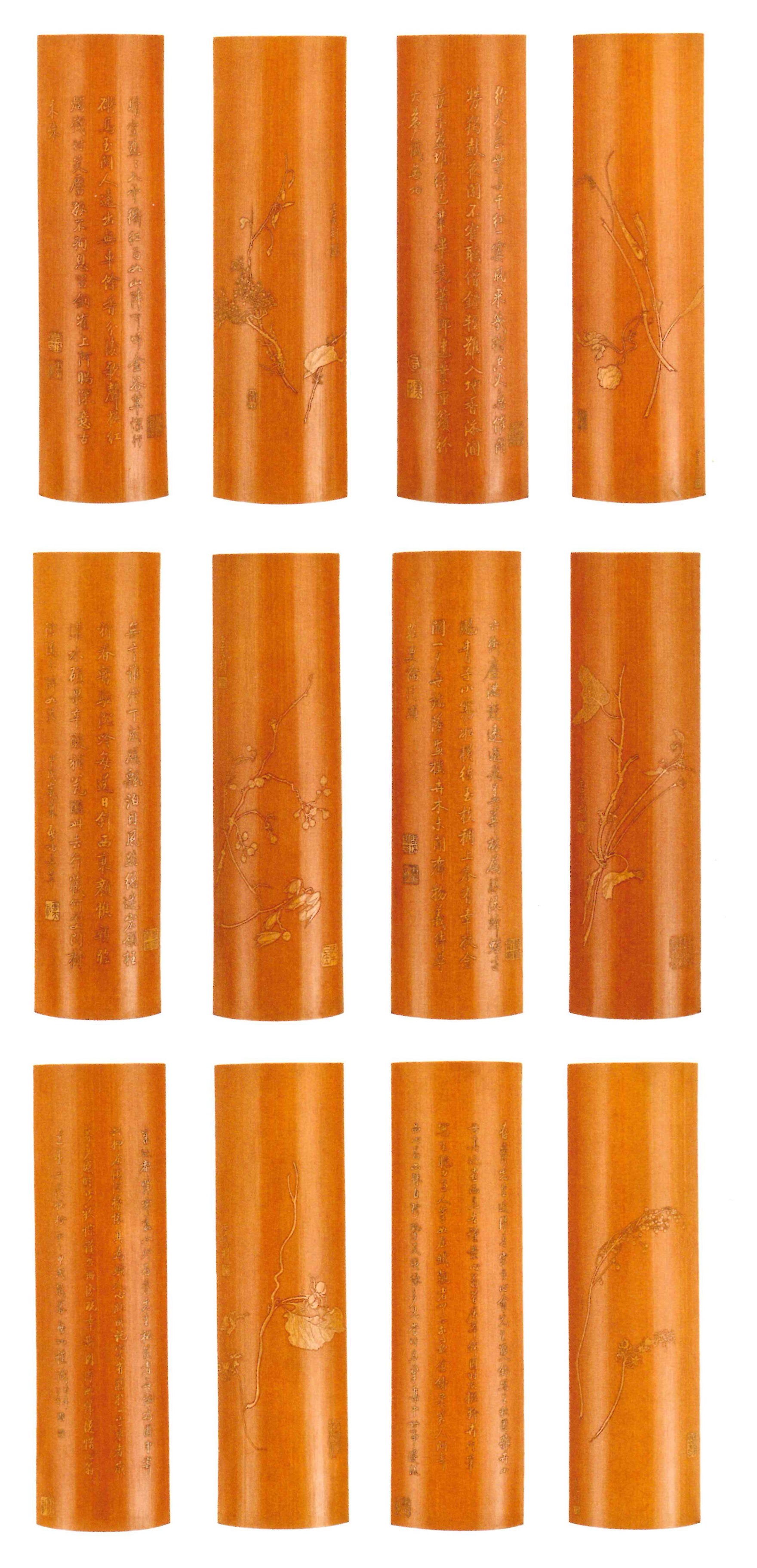
Wrist-rests carved with Pu Ru’s Flowers in Autumn Garden in liuqing low relief (A set of 12)
-
Carved by Bo Yuntian (1967 – )
Calligraphy by Qi Gong (1912 – 2005)
Designed by Kössen M. T. Ho (1963 – )
Marks of “Yuntian ke” and “Mengche yazhi”
Seals of “Bo”, “Mengche”, “Hua-e Jiaohui”, “Dong Qiao huanxi” and “Yuntian ke” -
2009 – 2010
-
Bamboo
-
Each H 33.9 cm W 9.8 cm
-
Hua-e Jiaohui Lou Collection donated by Dr Kössen M. T. Ho
Dr Ho commissioned Bo Yuntian to transform the six paintings of autumn flora along with Qi Gong’s colophon on the poem Falling Flowers into a set of bamboo wrist-rests carved in liuqing low relief. The outer surface of bamboo features a dense, smooth green layer of skin known as zhuqing or qingyun. In the liuqing technique, portions of this skin are retained to form the design, while the surrounding areas are removed to reveal the underlying fibrous grain. Pu Ru originally depicted the flora using a vigorous double-outline brushwork technique. The liuqing carving captures this effect by subtly varying the thickness of the bamboo skin to vividly outline the motifs, demonstrating exquisite craftsmanship. -
-
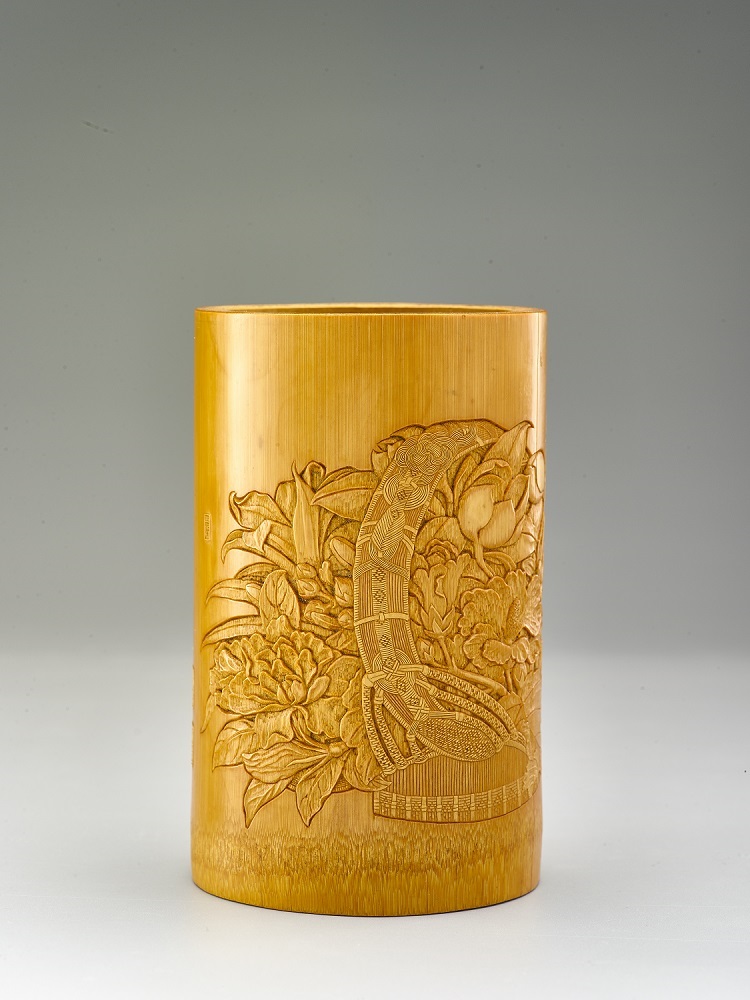
Brush pot carved with Li Song’s Basket of Flowers in sunken relief
-
Carved by Bo Yuntian (1967 – )
Designed by Kössen M. T. Ho (1963 – ) -
2012
-
Bamboo
-
H 15.5 cm Dia 9.5 cm
-
Hua-e Jiaohui Lou Collection donated by Dr Kössen M. T. Ho
The design on this brush pot is adapted from Li Song’s painting Basket of Flowers from the Southern Song dynasty. The various flowers depicted, including pomegranate, gardenia, and hollyhock, are all rendered using the sunken-relief carving technique. This brings out a striking three-dimensional effect, highlighting the plumpness of the petals and the fullness of the buds. The flower basket itself, however, is carved in low relief. The use of varying relief techniques brings the blooms vividly to life. -
-
“Yingying Burning Incense at Night” carved in the round
-
Zhou Hansheng (1942 – )
Mark of “Qishi erhou Hansheng”
Seal of “Zhou” -
2013
-
Bamboo
-
H 16 cm Dia 14.5 cm
-
Hua-e Jiaohui Lou Collection donated by Dr Kössen M. T. Ho
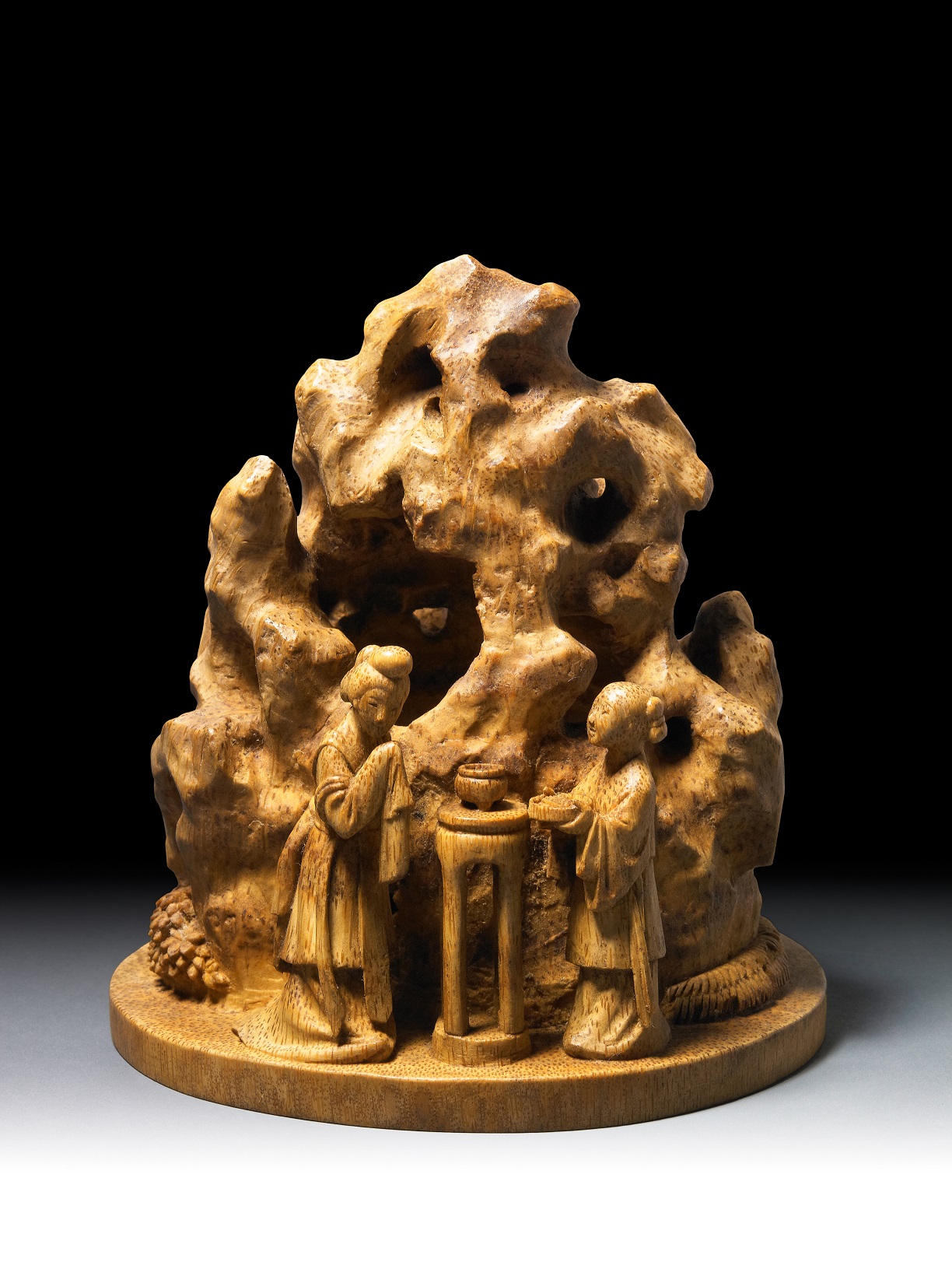
This work draws its inspiration from The Romance of the Western Chamber. The artisan cleverly utilises the hollow nature of the bamboo root to allow the figures to be seen through the crevices of the rock, visually interacting with one another and effectively compressing a classical garden scene into a miniature space. As viewers rotate and examine the piece from all angles, the narrative seems to unfold sequentially, creating a strong sense of dramatic tension. -
-
“Five-picul Gourd” carved in the round
-
Zhou Hansheng (1942 – )
Mark of “Hansheng”
Seal of “Zhou” -
2005
-
Bamboo
-
H 8.1 cm W 6.7 cm D 12 cm
-
Hua-e Jiaohui Lou Collection donated by Dr Kössen M. T. Ho
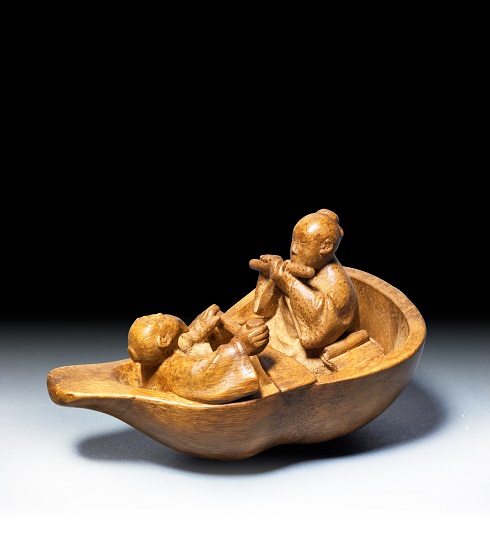
This work is inspired by the story of the “Five-picul Gourd” from the “Enjoyment in Untroubled Ease” chapter of the Zhuangzi. It serves as a metaphor that everything in the world has its own inherent value when put to its proper use. The carving depicts two figures crossing a river on a giant gourd. The artisan skilfully exploits the natural form of the root: the bottom of the gourd, the figures, and the paddle are all carved directly from the septa, demonstrating ingenious design and exquisite craftsmanship.
-
-
Gold brocade with hare design
-
Yuan dynasty (1271 – 1368)
-
Textile
-
37 x 25.6 cm
-
Hua-e Jiaohui Lou Collection donated by Dr Kössen M. T. Ho
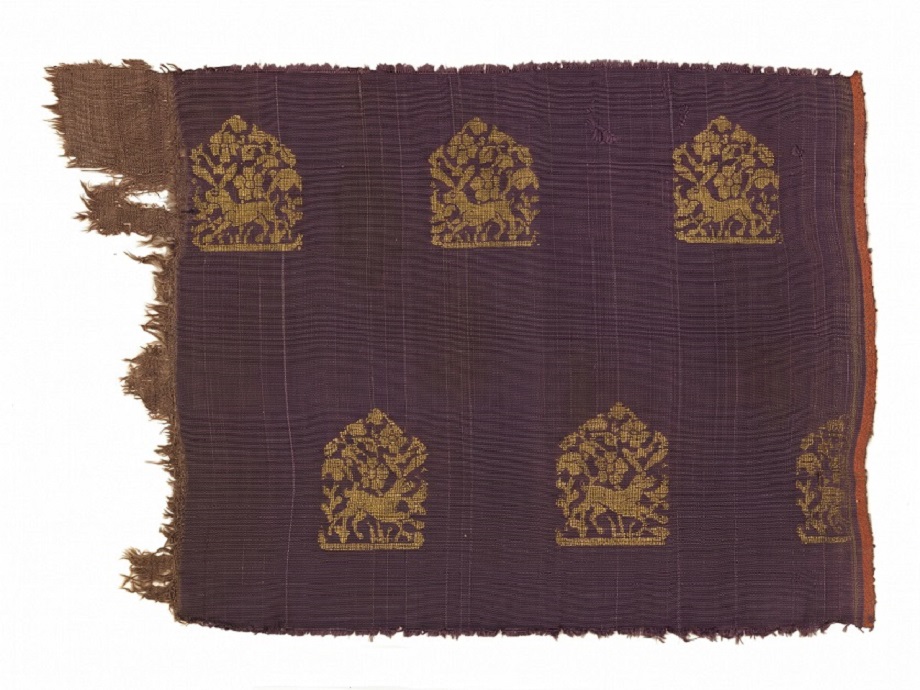
This textile was woven with purple wrap and weft threads, forming a background adorned by motifs shaped like a house in opposite directions of two alternate rows. Brocaded with goldwrapped plates, each pattern is decorated with a hare running amid flowers and vines. Hares were a popular auspicious motif in the Yuan dynasty. They were commonly applied on gold, silver and jade wares, as well as textiles. The Yuan people inherited the cultures of the Northern nomadic tribes of the Liao and Jin dynasties. As such, they adopted hunting motifs in their decorations derived from the theme of “spring by the water and autumn in the mountains”. Motifs of “spring by the water” would usually consist of waterfowl at lotus pond, while “autumn in the mountains” was often portrayed with scenes of beasts hunting their preys, which included animals such as tigers, gyrfalcons, deer and hares. The pattern of hares running amid flowers may represent the prey.
-
-
Brush pot carved with Yuan dynasty gold brocade hare design and “Song of Antique Beauty”
-
Written and carved by Fu Jiasheng (1958 – )
Designed by Kössen M. T. Ho (1963 – )
Marks of “Bingshen dong Jiasheng ti bing ke” and “Mengche yazhi”
Seals of “Fuca”, “Jiasheng zhi yin”, “Fu”, “Mengche” and “Hua-e Jiaohui” -
2017
-
Wood (Zitan)
-
H 14.6 cm Dia 13.4 cm
-
Hua-e Jiaohui Lou Collection donated by Dr Kössen M. T. Ho
This Yuan dynasty gold brocade features a running rabbit motif. Depicted in a dynamic, leaping posture, the rabbit is vigorous and lifelike, a design likely associated with the hunting customs of northern nomadic tribes. A comparable example is housed in the collection of the Cleveland Museum of Art.
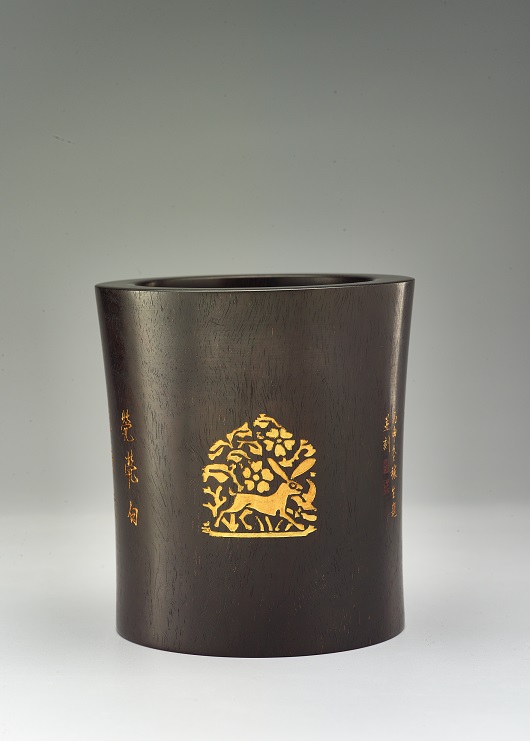
Dr Ho commissioned Fu Jiasheng to replicate this motif onto a brush pot through incision. The incised lines were subsequently gilded to echo the opulence of the original textile, with different treatments applied to the two rabbits: one is set against a gold ground, while the other is rendered in gold. The design is interspersed with the poem Guyan Ge (Song of Antique Beauty), calligraphed by Fu. This interplay between calligraphy and motif demonstrates exceptional creativity. The poem reads: “A solitary white rabbit, runs east yet looks west; clothes are best when new, but friends are best when old”. By contrasting new garments with old companions, the verse conveys a profound sentiment of cherishing enduring relationships and treasuring objects of the past. -
-
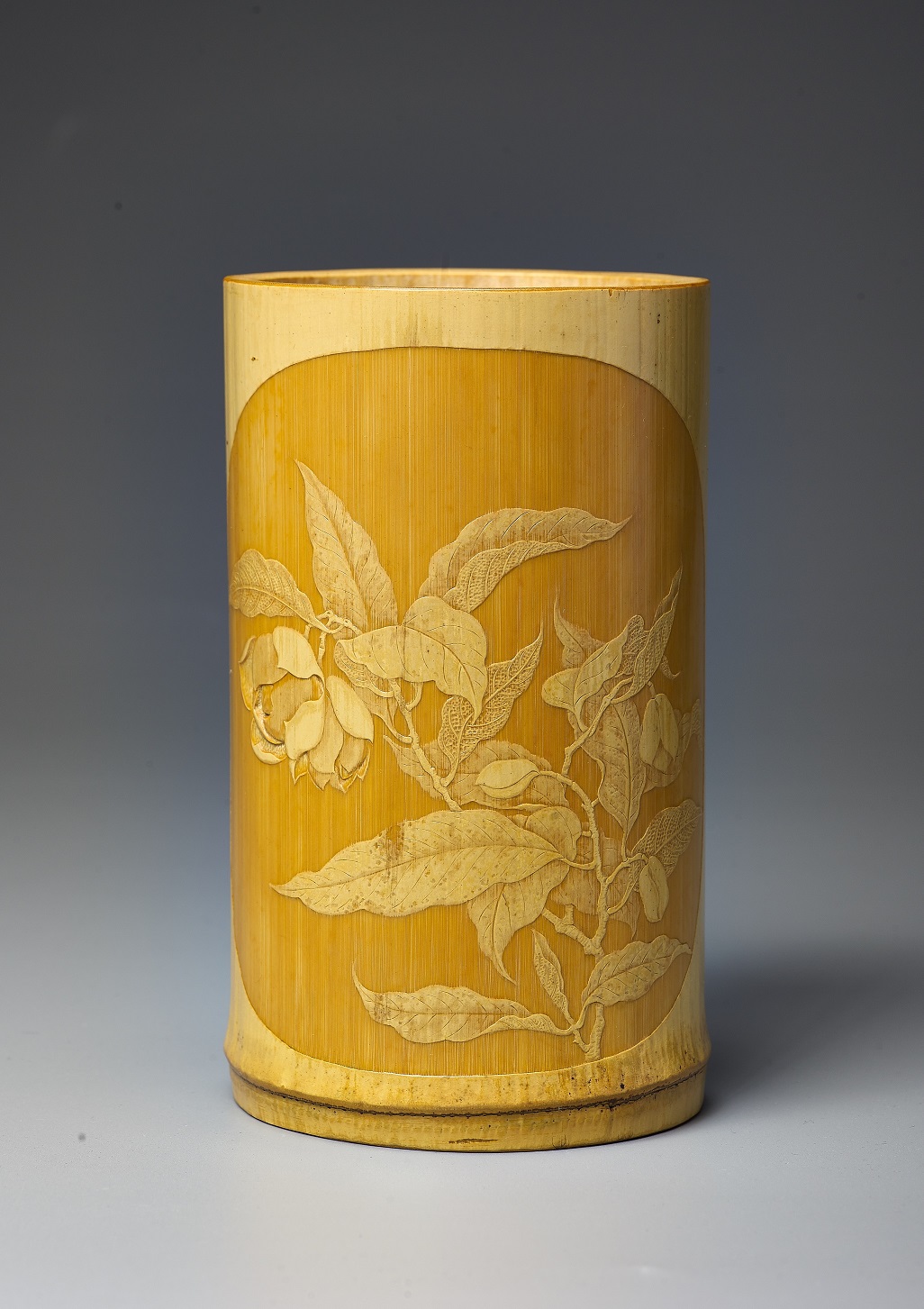
Brush pot carved with Magnolia Coco in liuqing low relief
-
Carved by Zhu Xiaohua (1958 – )
Designed by Kössen M. T. Ho (1963 – )
Mark of “Yehehuatu Renchen muqiu Jingnan zhuren Xiaohua ke”
Seals of “Zhu“, “Xiaohua”, “Mengche” and “Hua-e Jiaohui” -
2012
-
Bamboo
-
H 16.2 cm Dia 9.4 cm
-
Hua-e Jiaohui Lou Collection donated by Dr Kössen M. T. Ho
In the original Song dynasty painting, the magnolia coco flowers are delineated with fine brushstrokes to capture their contours and veins. They are rendered with light colour washes and dotted with white pigment for the stamens, creating distinct layers and a vividly lifelike appearance. This brush pot cleverly references the fan-shaped composition of the original painting, framing it within a reserved panel. The artisan utilises the varying thickness of the bamboo skin to convey depth, employing thicker areas for the foreground and thinner areas for elements further back. The mottled texture of the leaves, the ruggedness of the branches, and the delicate beauty of the petals are all meticulously captured down to the finest detail within the bamboo skin. Among them is a half-open flower bud on the verge of blooming, for which the artisan specifically employed the sunken-relief carving technique. This accentuates the three-dimensional effect of the petals, making the blossom spring to life from the bamboo surface and imbuing the work with a lively charm.
-
-
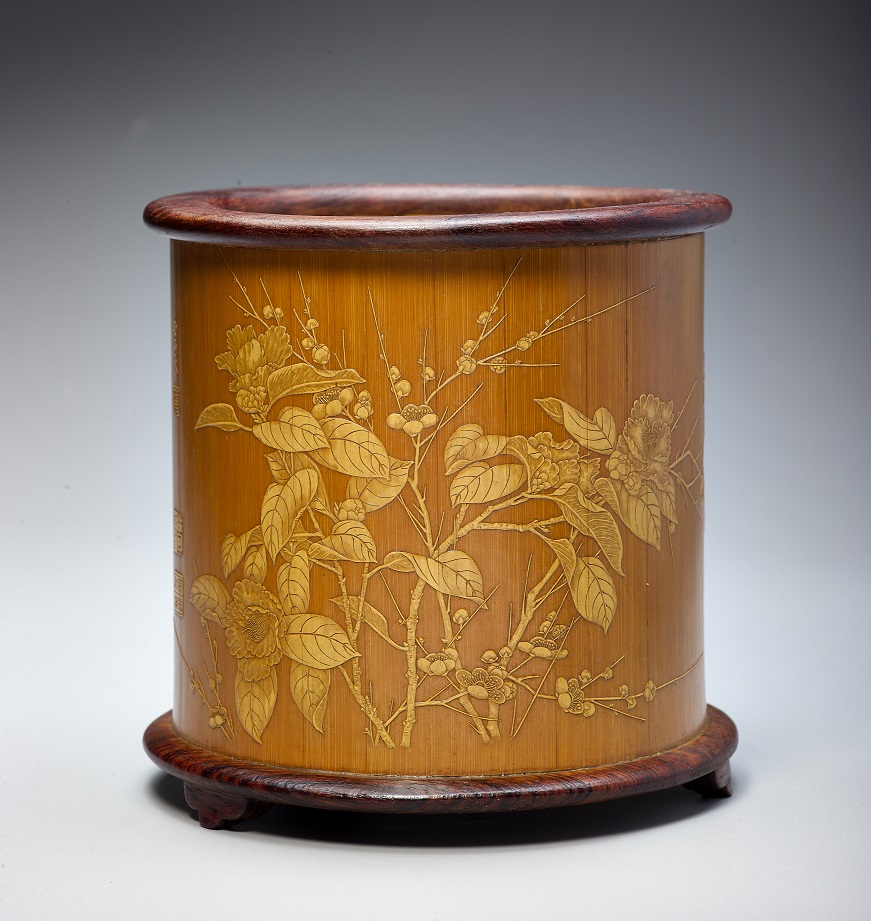
Brush pot carved with plum blossom and camilia from Song Hundred Flowers in liuqing low relief
-
Carved by Bo Yuntian (1967 – )
Designed by Kössen M. T. Ho (1963 – )
Mark of “Yuntian”
Seals of “Bo”, “Mengche” and “Hua-e Jiaohui” -
2009
-
Bamboo
-
H 15.8 cm Dia 17 cm
-
Hua-e Jiaohui Lou Collection donated by Dr Kössen M. T. Ho
This brush pot features a motif of plum blossoms and camellias, selected from the opening section of the Song dynasty handscroll Hundred Flowers, carved in liuqing low relief. In the original painting, the flowers and leaves are meticulously outlined and rendered with mere ink washes. Transposed into the medium of bamboo carving, the artisan relies solely on the varying thickness of the bamboo skin to articulate the layers of the flora. Similarly devoid of colour, the carving seamlessly inherits the subtle and elegant charm of the original masterpiece.
The gracefully extending plum branches of the original painting are adapted into a panoramic composition around the cylindrical body. As the brush pot is rotated, the scene unfolds like a slowly unrolling handscroll, offering a deeply engaging viewing experience. As a poetic verse describes, “Under a pale moon, the jade-like plum blossoms appear even more slender; in deep snow, the red camellias seem ready to ignite.” The winter plum is celebrated for its elegant refinement, while the camellia is praised for its vibrant beauty. Though distinct in their allure, both endure the bitter cold of winter, implicitly resonating with the resilient and vigorous spirit of bamboo.
-
-
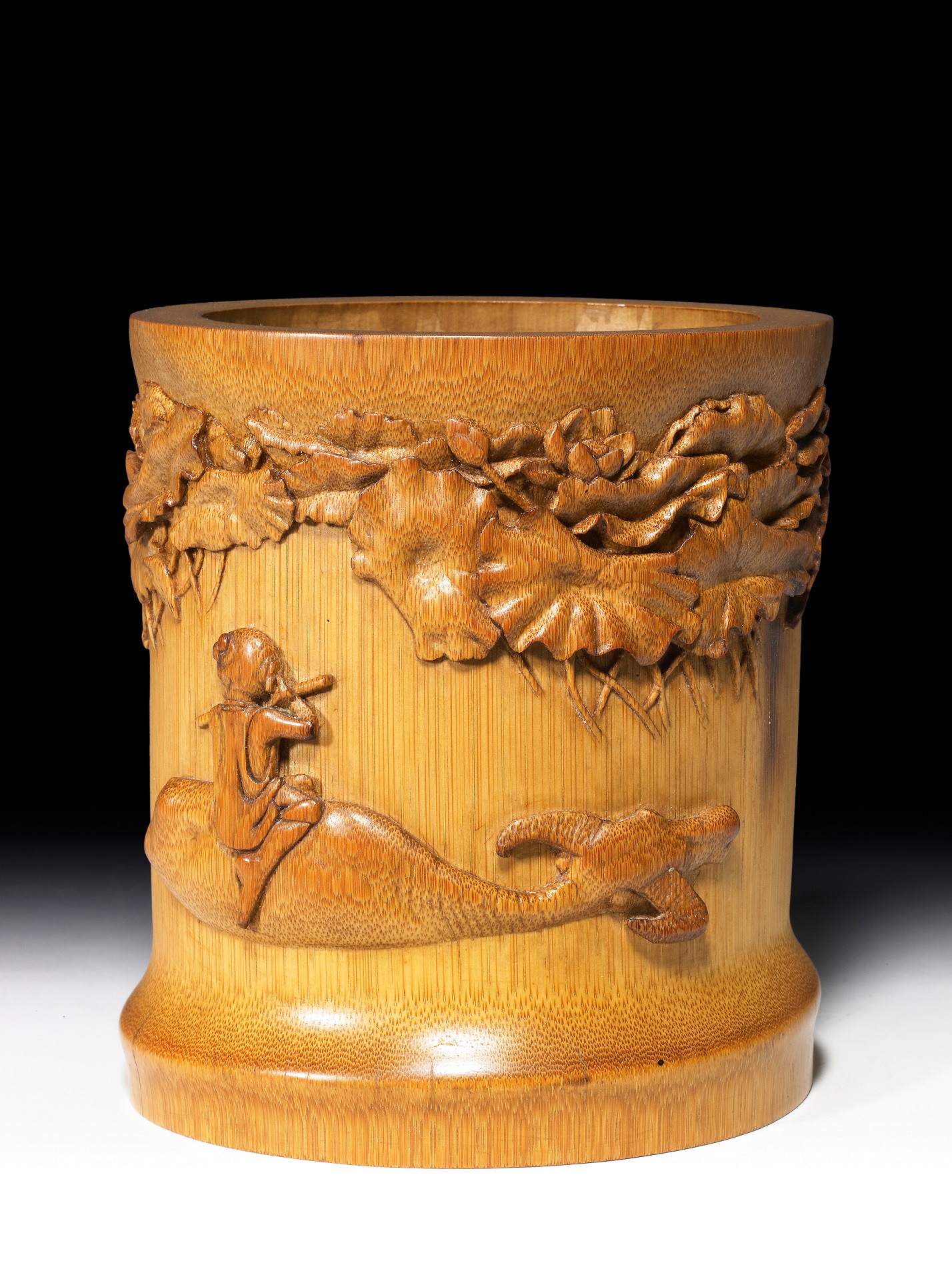
Brush pot carved with “Herding in a Lotus Pond” design in high relief
-
Zhou Hansheng (1942 – )
Mark of “Hansheng”
Seal of “Zhou” -
1984
-
Bamboo
-
H 15 cm Dia 13.5 cm
-
Hua-e Jiaohui Lou Collection donated by Dr Kössen M. T. Ho
This brush pot features an ingenious panoramic composition. The plain bamboo ground serves as the water, with lotus leaves encircling the upper wall. Below, a herd boy on a buffalo is depicted with his back to the viewer, employing a distinctive upward perspective to create depth. Taking advantage of the thick bamboo wall, the artisan masterfully employed high relief carving. The overlapping lotus flowers and leaves slant and tilt in various directions, their edges curling and unfurling as if swept by a gentle breeze, infusing the static scene with dynamic movement. Skillfully utilising the relief technique throughout the vessel, the artisan creates a distinct sense of depth between the musculature of the buffaloes and the lotus pond scenery. The interplay of light and shadow brings the piece to life, brimming with rustic charm. -
Flowers in Autumn GardenWrist-rests carved with Pu Ru’s Flowers in Autumn Garden in liuqing low relief (A set of 12)Brush pot carved with Li Song’s Basket of Flowers in sunken relief“Yingying Burning Incense at Night” carved in the round“Five-picul Gourd” carved in the roundGold brocade with hare designBrush pot carved with Yuan dynasty gold brocade hare design and “Song of Antique Beauty”Brush pot carved with Magnolia Coco in liuqing low reliefBrush pot carved with plum blossom and camilia from Song Hundred Flowers in liuqing low reliefBrush pot carved with “Herding in a Lotus Pond” design in high relief